

The Birmingham Economic Review is out now!
This year’s report will provide a comprehensive analysis of the city’s economy amid the wider geopolitical landscape, and actionable measures that businesses and stakeholders from across the city-region can take to drive economic growth.
Read the full Birmingham Economic Review 2025.
Kostas Kollydas explains how graduate job opportunities have sharply declined—nationally and in Greater Birmingham—due to economic pressures, sector changes, and the growing influence of AI, and discusses what skills and policies are needed to support graduates entering a tougher labour market.
Debates on the changing graduate labour market
A recent Financial Times article reports that since the launch of ChatGPT in 2022, job postings for graduate-entry roles have fallen sharply in the UK and the USA. In the UK, such listings dropped by almost two-thirds, while in the USA the fall reached 43%. Banking, finance, software development, and accounting saw the largest reductions in graduate vacancies. However, jobs also fell in roles that are considered less exposed to Artificial Intelligence (AI), such as human resources and civil engineering. Analysts argue that economic uncertainty, reduced venture capital funding, and offshoring have significantly influenced the downturn in graduate hiring. In both countries, there is limited evidence that AI alone explains this decline, as patterns differ across occupations. Some economists believe it is premature to link AI directly to the current labour market slowdown. Others argue that young workers familiar with AI may, in time, find new job openings by using the technology to improve their productivity and compensate for limited experience.
Recent evidence from the USA shows that employment among early-career workers in highly AI-exposed occupations (such as software development and customer service) has dropped since the release of generative AI tools, even as employment for older, more experienced workers in the same fields has continued to grow. AI appears to have the strongest impact where tasks can be easily automated, while roles that use AI to support or enhance work are less affected.
Graduate job demand in the Greater Birmingham area
It is possible to explore the demand for jobs where employers use the term ‘graduate’ in their advert text (hereafter ‘graduate jobs’) in the Greater Birmingham area. These jobs typically refer to entry-level roles, structured graduate schemes, or training programmes that employers often use to recruit and develop recent graduates.
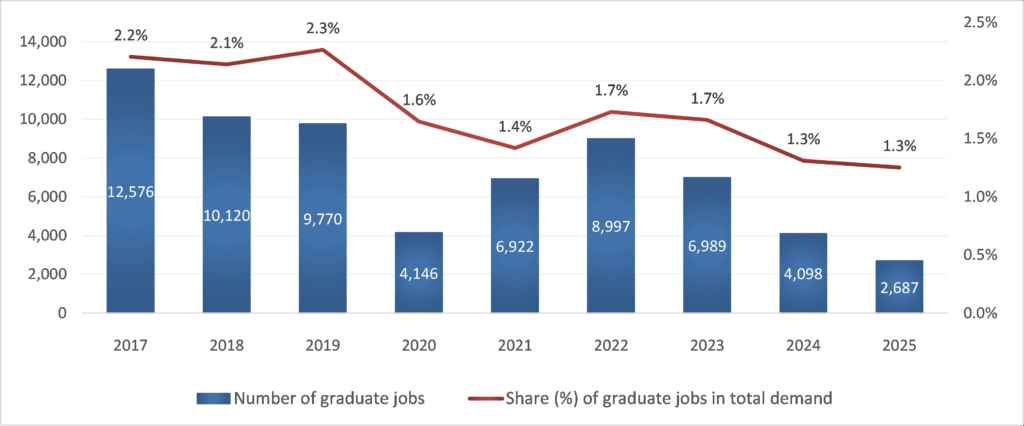
Adzuna online job posting data show that the number of graduate jobs in the Greater Birmingham area decreased from 12,600 in 2017 to 4,150 in 2020 (see Figure 1). This sharp decline can be attributed to the COVID-19 pandemic, when hiring paused or slowed in most sectors. Numbers recovered to around 9,000 in 2022 but dropped again to just 2,700 in the first three quarters of 2025. This remarkable decrease in the number of graduate jobs since 2022 (nearly 70%) was steeper than the 59% decrease in the overall number of job postings. As a result, the share of graduate jobs in total demand slipped from 1.7% in 2022 to 1.3% in 2025.
This figure is nearly one percentage point lower than pre-pandemic levels. Nationally, the number of graduate jobs fell by 72% between 2019 and 2025, with graduate jobs accounting for 1.4% of total UK demand in 2025. This picture may reflect more limited recruitment budgets by employers and the likely substitution of some skilled graduate tasks by AI-related automation, particularly in areas such as finance, law, and medicine.
Industry patterns in graduate job demand
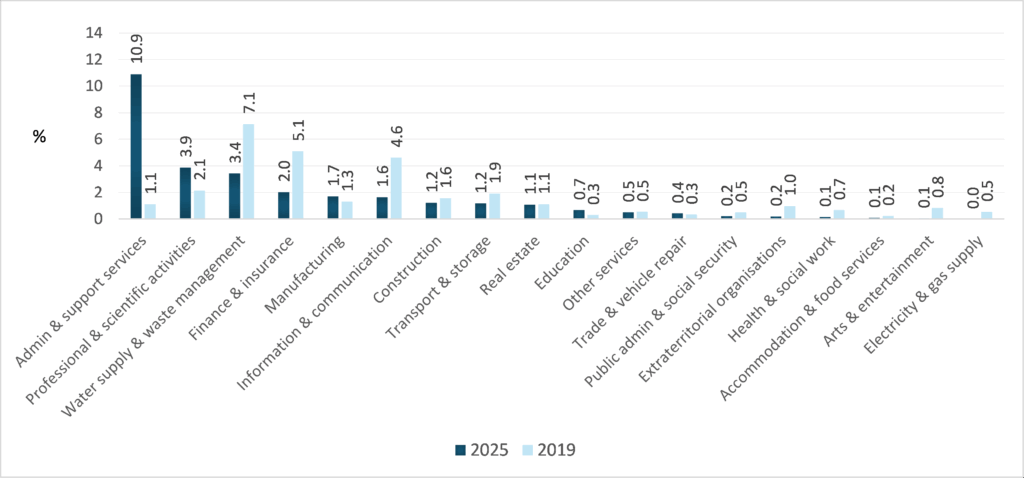
In 2025, most graduate jobs in the Greater Birmingham area were in the ‘admin & support services’ and ‘professional, scientific & technical activities’ industries. Compared with 2019, some of the largest declines in the shares of graduate jobs in total demand occurred in ‘finance & insurance’ and ‘information & communication’ (Figure 2). The rise in admin and support services may indicate that more graduates are being channelled into lower-skilled or routine roles, as opportunities in traditional graduate sectors contract. However, this industry also includes some more skilled functions such as employment services and business support activities, which may have drawn in degree-level candidates. The increase may also reflect greater recruitment activity by graduate-focused employment agencies, which are included in this industry. The fall in the shares for the finance and information sectors may signal reduced hiring for certain analytical and technical roles as firms sought to control costs and restructured after the pandemic (for example, by limiting high-skill job openings), while automation may have replaced some entry-level tasks.
At the UK level, ‘admin & support services’ remained the industry with the highest share of graduate jobs in total demand in 2025, although at a much lower proportion than in the Greater Birmingham area (4.2% versus 10.9%). Nevertheless, the steepest declines in graduate job shares since 2019 were recorded in the ‘transport & storage’, ‘manufacturing’, and ‘construction’ industries, which may partly reflect the lingering effects of the COVID-19 pandemic on these sectors.
Pay and skills trends in graduate jobs
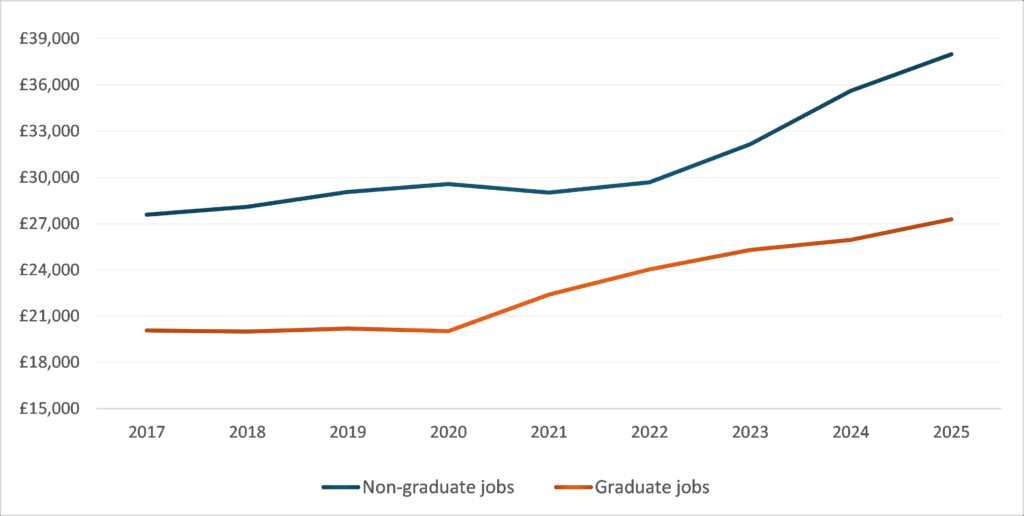
In recent years, median salaries for graduate jobs in the Greater Birmingham area have increased at a slower pace than those for non-graduate roles (Figure 3). The gap in advertised median salaries between non-graduate and graduate jobs narrowed during the pandemic (from 48% in 2020 to 23% in 2022).[7] Since then, however, this pay gap has gradually widened again (39% in 2025). This pattern mirrors the fall in demand for graduate jobs described above. As noted earlier, graduate jobs are typically entry-level roles, so the lower pay levels likely reflect both limited work experience and younger age profiles among graduates. At the UK level, graduate jobs have slightly higher median salaries compared to those in the Greater Birmingham area. Nationally, the pay gap between non-graduate and graduate jobs is relatively lower (35% in 2025).
In 2025, the skills most often requested in graduate job postings in the Greater Birmingham area were specialist, soft, and business skills. More specifically, nearly all postings asked for at least some ‘specialised occupational skills’. Some of the most sought-after specialised skills included working with clients, teaching, management, engineering, and sales. The next most prominent skills group comprised soft skills (mainly communication, assertiveness, planning, and problem solving). Business and administrative, marketing, and media and communications skills were also common. This signifies the importance of commercial awareness and digital engagement. Additionally, graduate jobs often require expertise in education and training, engineering, and business management. Health care and science and research completed the top ten skills groups for graduate roles in the Greater Birmingham area in 2025. Together, these patterns indicate that employers seek a blend of technical knowledge and interpersonal skills in graduate jobs.
Conclusion
The labour market now appears tougher than formerly for recent graduates in the Greater Birmingham area, as well as across the UK. Many employers have reduced recruitment for entry-level roles and often prioritise the reduction of costs. At the same time, demand for skills has been affected by new technologies and automation.
In this context, policy should respond on both fronts. It is important that graduates develop the mix of skills that are valued by employers. Employers, in turn, need the right support to offer good entry-level jobs. Therefore, it is critical to develop stronger links between universities, colleges, training providers, and local businesses. This would facilitate greater alignment of skills supply and skills demand. Moreover, as new sectors grow (such as green industries and digital services) there are opportunities to shape the next generation of graduate workers, instead of merely reacting to the current decline in graduate demand.
Figure 1. Graduate jobs in the Greater Birmingham area (2017-2025)
Source: Adzuna Intelligence, authors’ own calculations
Figure 2. Share (%) of graduate jobs in total demand by industry in the Greater Birmingham area (2025, compared with 2019 shares)
Source: Adzuna Intelligence, authors’ own calculations
Figure 3. Median salaries for graduate and non-graduate jobs in the Greater Birmingham area (2017-2025)
Source: Adzuna Intelligence, authors’ own calculations