
Author: Chris Greasley, Research Applications Specialist
The Research Software Group (RSG) Hackathon returned for its third edition this April with a growing team and a new one-week format. Like previous editions, RSG members had time dedicated to taking part in a wide range of sessions.
These covered everything from developing reusable container images for Continuous Integration (CI) pipelines to group discussions on career pathways. The broad range of sessions gave everyone the chance to work with others they don’t normally work with, which allowed the sharing of ideas and approaches.
A number of sessions revolved around tools and infrastructure. These included work on building container images for use in CI pipelines. One such session brought together a mix of experience: R and containerisation development knowledge through to troubleshooting and documentation. The work continued beyond the session, resulting in a successful run of the CI on a demo repository.
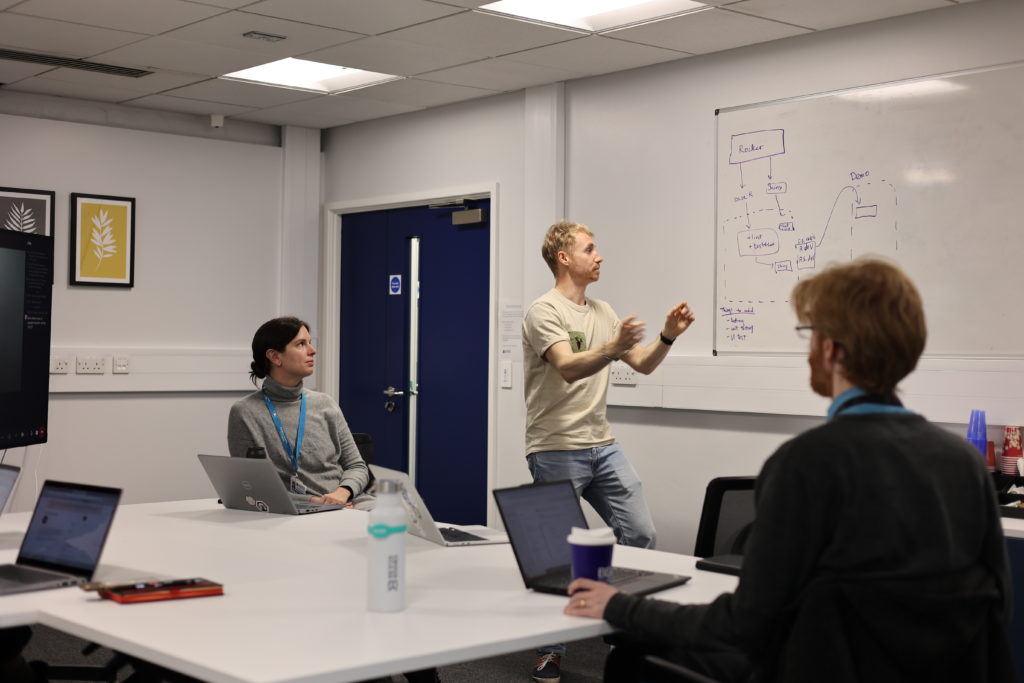
Other sessions took a more exploratory approach. One looked at the process behind developing a new Fortran codebase, including modern tooling as well as resolving the many hurdles people might encounter when setting up their own development environments. Fortran remains an enduringly important language in many scientific disciplines and the session brought together people who had first encountered Fortran in very different eras!
Another workshop focused on debugging and profiling, showcasing the capabilities of useful tools like GDB and Valgrind. This made use of small demo programs some group members had encountered at workshops earlier in the year and led to good sharing of language debugging knowledge.
Some teams within the RSG spend a lot of time working on backend system architecture and stitching together various services that underpin BlueBEAR. Accordingly, there was a deep dive into system design and authentication flow, where participants set up a Keycloak server and a Django Ninja API and experimented with token-based authentication and building small client apps to interact with them. Here, the emphasis was on trying different things out, comparing approaches, and finding a particularly elegant solution.
There were also opportunities to look at improving standards in our regular work. The accessibility session introduced tools and approaches for testing, with a particular focus on finding issues relating to screen reader use since this is an area easily missed by sighted developers. These tools were then applied directly to production websites. This led to updated accessibility statements and new templates to support future accessibility work.
Alongside these technical sessions, there was also time focussed on how we work as a group and develop as professionals. One session explored an ongoing project on career development aimed at better defining progression pathways. This included short presentations from some members of the group about their varied career pathways, followed by very thought-provoking break-out discussions on which competencies and skills were most important to our roles and which were most realistic to develop. These discussions were constructive and will feed directly into the ongoing Career Pathways project.
Another session revolved around sharing experiences and processes of applying for funding and exploring opportunities where RSEs can take on more leading roles in this area. The RSG contains people with experience of successfully applying for grants or fellowships, which made it a valuable opportunity to discuss the process in a practical way.
Finally, the week included time spent looking at the wider RSE community. The Research Data Science (RDSci) team within the RSG focused on planning a proposed event at a national RSE conference, aimed at bringing together people in similar roles from across the UK to share practice and discuss common challenges. This reflects the group’s strong engagement with the wider RSE community, which has been a not insignificant factor in the RSG’s growth.
The 2026 iteration of the RSG Hackathon was another great success. While the group has continued to grow over the years, there has been no loss of appetite for collaboration, and having dedicated time to work together, beyond normal project work, was again seen as very positive. As a bonus, several sessions lead directly to improvements in ongoing work!