
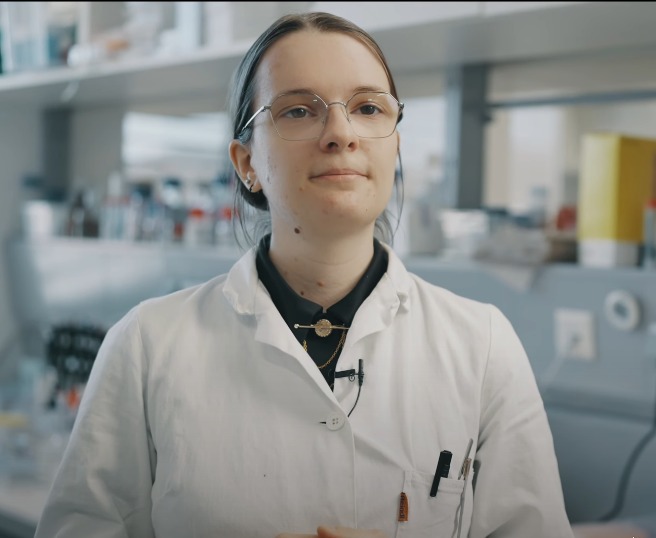
In this case study, we hear from Sarah Berger, a researcher working in Bioinformatics, who has been using BlueBEAR to develop proteins that can bind to metals.
Magnetic resonance imaging (MRI) is an essential diagnostic tool, particularly powerful when combined with contrast agents. Most state-of-the-art MRI contrast agents are based on the metal gadolinium, which has intrinsic physical properties that make it active in the MRI.
To ensure safe use in patients and to modify the metal’s behaviour, gadolinium ions are currently encapsulated by small-molecule ligands. Early studies have shown that protein-based systems could offer better performance than small-molecule systems.
Proteins are large biological molecules built from combinations of 20 different amino acids, forming an amino acid sequence. Rather than remaining as simple linear chains, proteins fold into complex three-dimensional structures, a process known as protein folding.
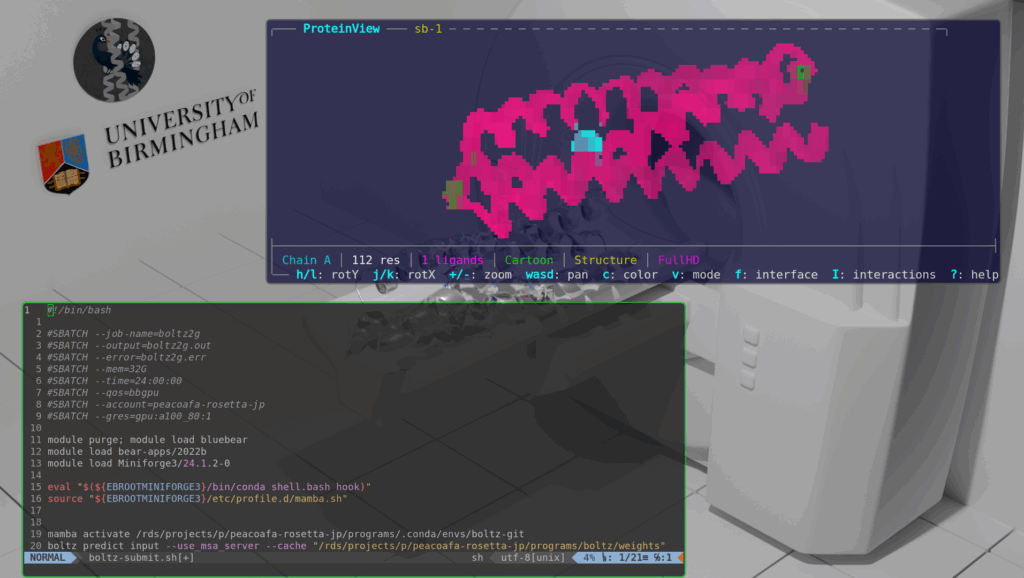
The availability of databases of experimentally determined protein structures and their sequences, combined with advances in artificial intelligence (AI), has made it increasingly feasible to predict protein structures from sequences and vice versa. In the Peacock group, we focus on developing proteins that can bind metals such as gadolinium. In our work, we use AI-based tools running on BEAR, which provides the powerful GPUs needed, to design entirely new proteins from scratch. These designed proteins are then produced in the lab and tested for their performance as MRI contrast agents.
We were so pleased to hear how Sarah was able to make use of what is on offer from Advanced Research Computing. If you have any examples of how it has helped your research then do get in contact with us at bearinfo@contacts.bham.ac.uk.
We are always looking for good examples of the use of High Performance Computing to nominate for HPC Wire Awards – see our recent winner for more details.