
In this case study, we hear from Samuel Montero Hernandez, an Assistant Professor of Computer Science, who uses BlueBEAR to develop methods for better understanding how the brain responds to complex, real-world stimuli.
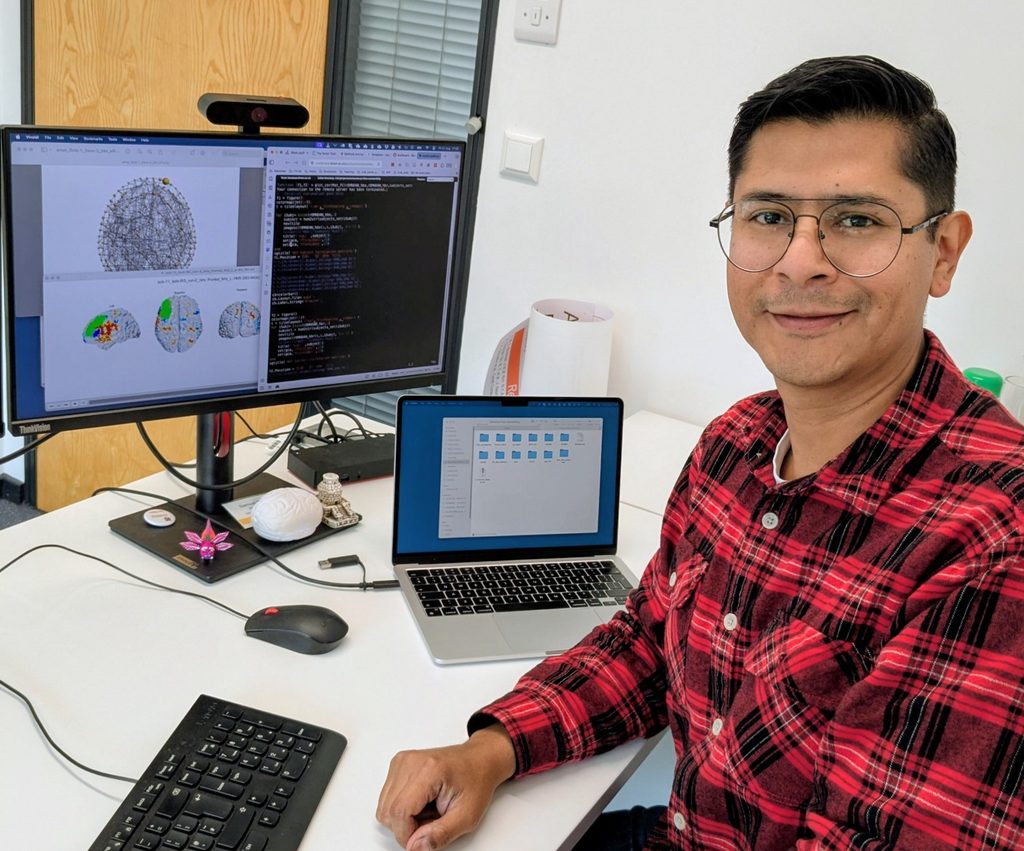
I am an Assistant Professor in Computer Science at the University of Birmingham, where my research focuses on analysis and methodological development, with expertise spanning connectivity, quality control and data-driven modelling of optical neuroimaging
A major focus of my work is developing methods to better understand how the brain responds to complex, real-world stimuli using functional near-infrared spectroscopy (fNIRS) and diffuse optical tomography (DOT).
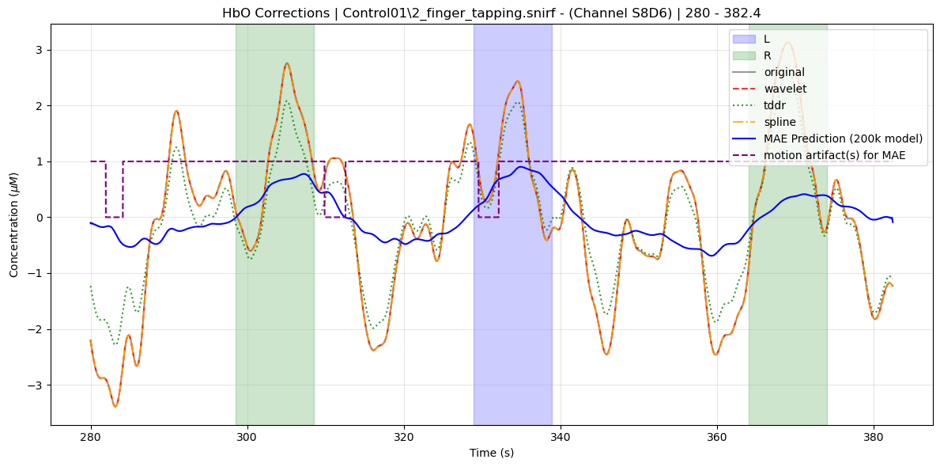
One of my projects employs a Masked Autoencoder (MAE) approach to correct motion artefacts in fNIRS signals. Inspired by MAEs from computer vision, our model learns to reconstruct signals from partial observations. We adapted the architecture for 1D autocorrelated noisy signals, introducing signal-specific patching, unpatching and positional encoding. Like the original MAE, it uses patch and positional embeddings, Transformer-based encoding, class and mask tokens, and encoder-decoder components. However, unlike the original architecture, both the encoder and decoder are essential because signal reconstruction is the primary goal.
A second project explores multimodal brain decoding with high-density DOT, investigating whether brain signals can support meaningful descriptions of audiovisual scenes and enable cross-modal prediction using brain data alone. We are developing a JEPA-based multimodal encoder and LLM decoder to connect brain, video and audio representations.
BEAR provides the computational capacity needed to train, evaluate and scale these models, accelerating our research from methodological development towards reproducible, open neuroimaging tools.
We were pleased to hear how Samuel was able to use what is on offer from Advanced Research Computing. If you have any examples of how it has helped your research, please get in touch with us at bearinfo@contacts.bham.ac.uk.
We are always looking for good examples of the use of High Performance Computing to nominate for HPC Wire Awards – see our recent winner for more details.