
The Birmingham Economic Review is out now!
This year’s report will provide a comprehensive analysis of the city’s economy amid the wider geopolitical landscape, and actionable measures that businesses and stakeholders from across the city-region can take to drive economic growth.
Read the full Birmingham Economic Review 2025.
Dr. Magda Cepeda-Zorrilla examines the health, environmental and economic benefits of electric vehicle adoption and assesses the UK and West Midlands’ progress in expanding EV charging infrastructure to support a successful transition away from petrol and diesel cars.
Benefits and policy momentum
The annual mortality from human-made air pollution in the UK is between 28,000 and 36,000 deaths annually. Air pollutants from petrol/diesel vehicles, (e.g. PM and NOₓ), were estimated to cost the NHS and social care system £1.6 billion (between 2017 and 2025). In England, the estimated economic cost of road (urban) noise is between £7 and £10 billion annually.
EVs have zero tailpipe emissions (no CO₂ and no NOₓ), so widespread EV adoption is considered essential to meet governmental carbon-budget targets, improve urban air quality and tackle noise pollution. To achieve this, the UK government plans to phase out new petrol and diesel cars by 2035 and for all new cars and vans to be 100% zero-emission. But it is crucial to have the rapid development of a reliable charging network to enable mass EV adoption. Understanding the current state of charging provision at the national and regional levels, particularly in the West Midlands, is essential for identifying progress and the boroughs lagging behind.
Charging infrastructure in England and the West Midlands
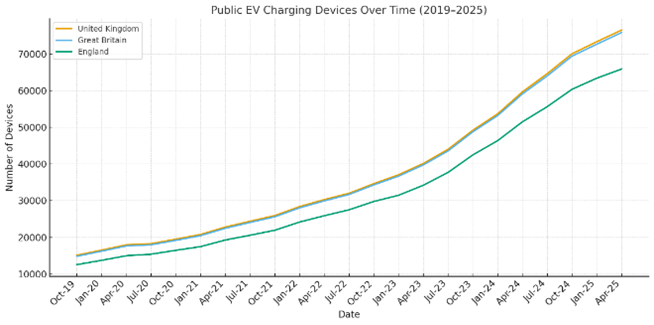
Data on charging infrastructure shows progress regarding the number and power of the chargers. Up to April 2025, statistics show 76,507 publicly available EV charging devices in the UK (DfT, 2025) (Fig. 1).
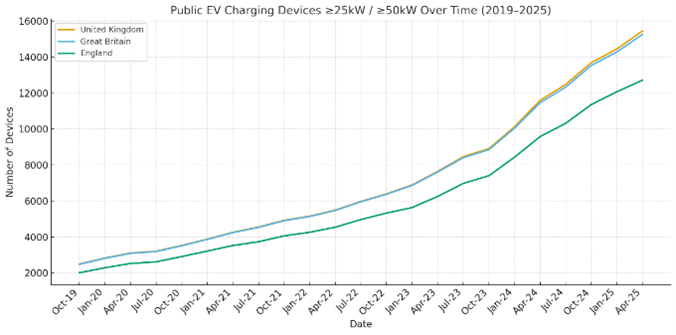
Across the UK and England there has been a steadily increase. With two thresholds, one in early 2023 (40,000 chargers) and late 2024 (70,000 chargers). Looking at the number of chargers by speed (Fig. 2) there was a steady growth and an increase from approximately 2,500 devices in 2019 to more than 15,000 by Apr-2025 in the UK. In 2022, there was also a growth of higher power chargers.
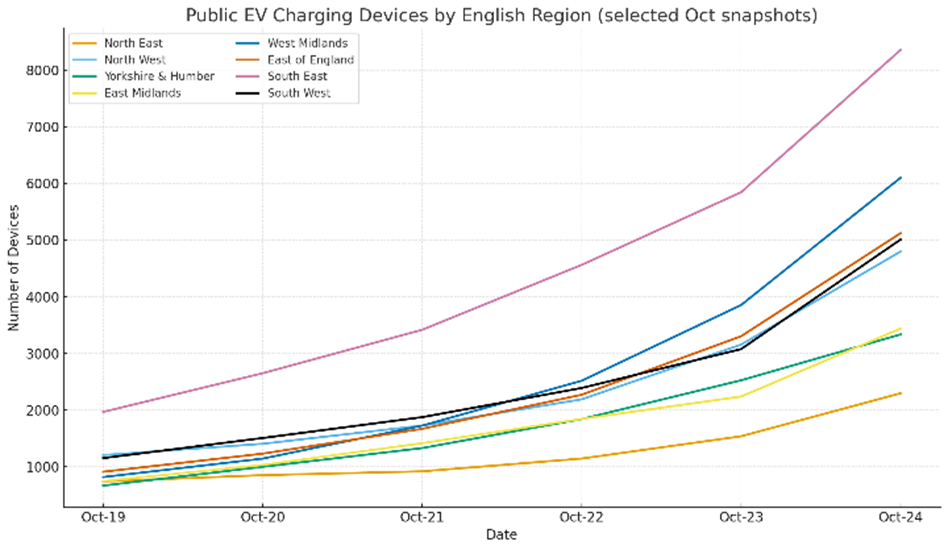
The English Regions show a consistent growth, however, there is a pronounce growth from the South East followed by the West Midlands whilst the North East is performing at the lowest (Fig.3).
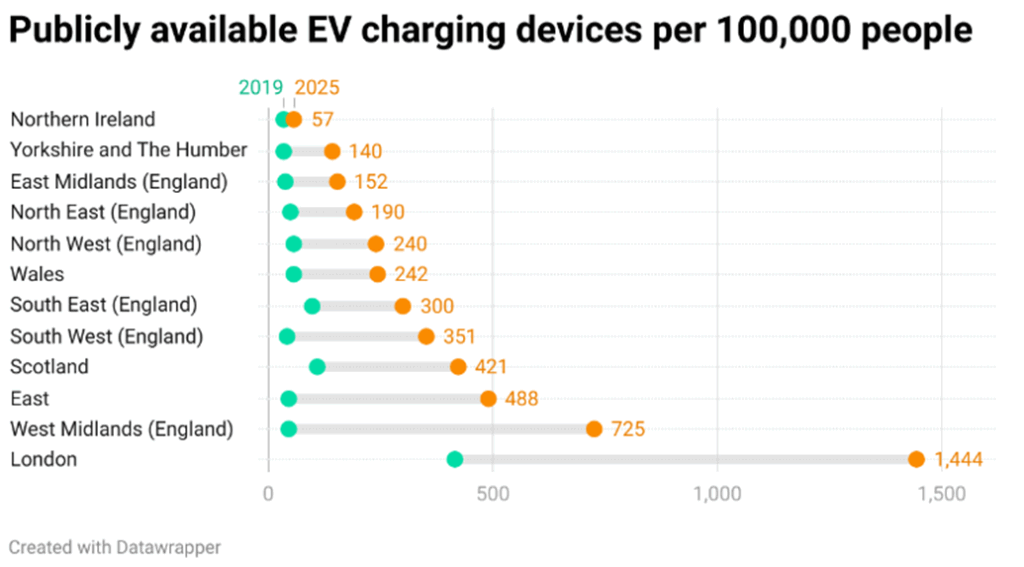
In addition to the growth in charging devices across the regions it is important to look at the population-adjusted provision to contextualise accessibility. Figure 4 shows the disparities across the regions in the number of publicly available EV charging devices per 100,000 people (comparison between 2019 and 2025). Perhaps is not surprising to see London exceeding other regions, however, those that remain below 150 are Northern Ireland and Yorkshire and The Humber whereas the West Midlands region shows notable improvement.
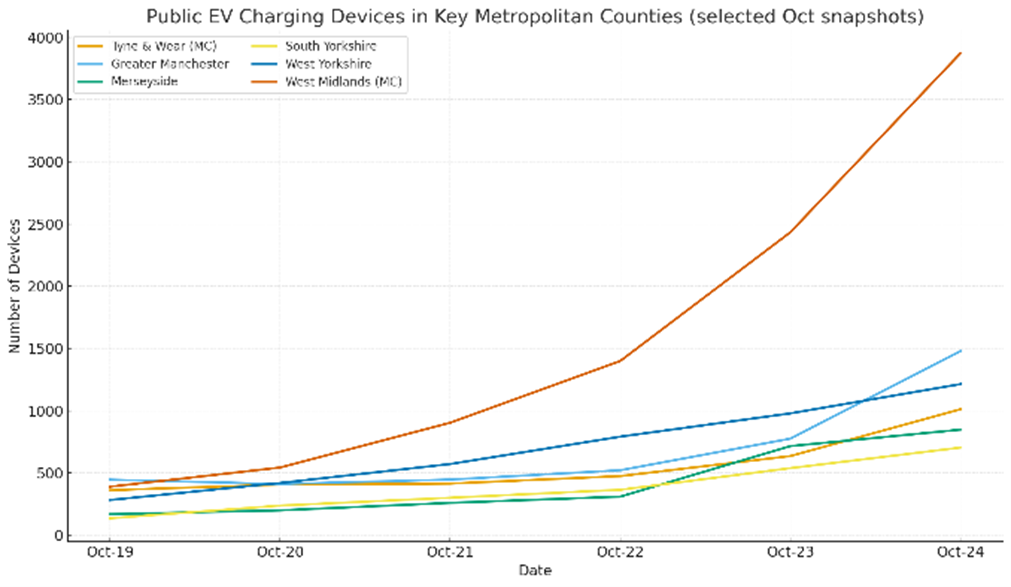
Regarding the key metropolitan counties, the West Midlands Metropolitan County is notoriously leading with more than 4000 public EV chargers, in comparison with other counties that rest far behind (Fig. 5).
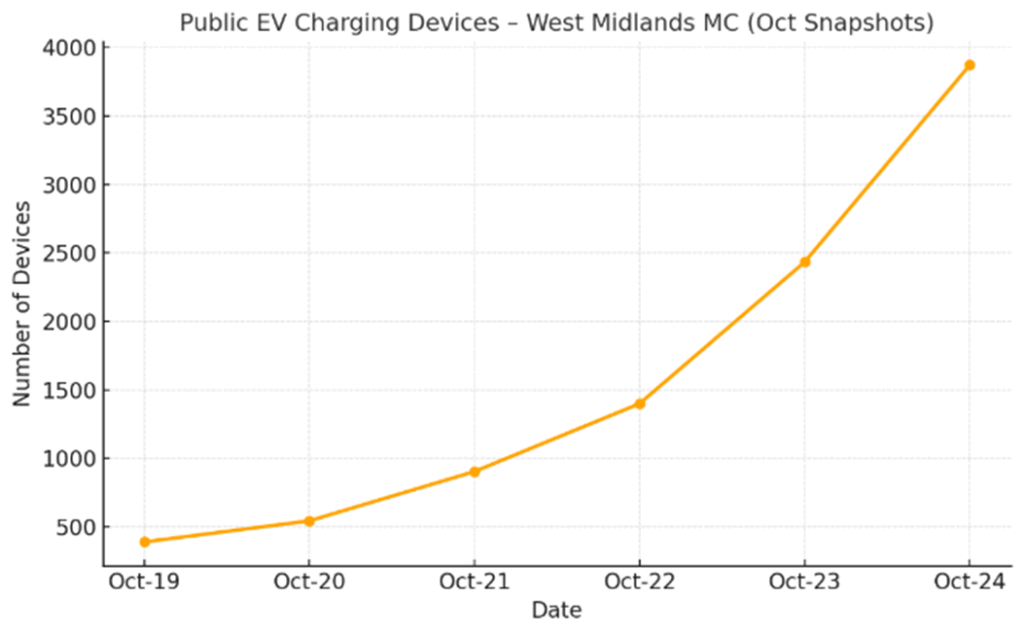
The total growth for the West Midlands Metropolitan Conty (Fig. 6) shows that from a less than 1000 public EV chargers between 2019-2021, there is a growth in 2022 and from then until 2024 a sustained steady increase.
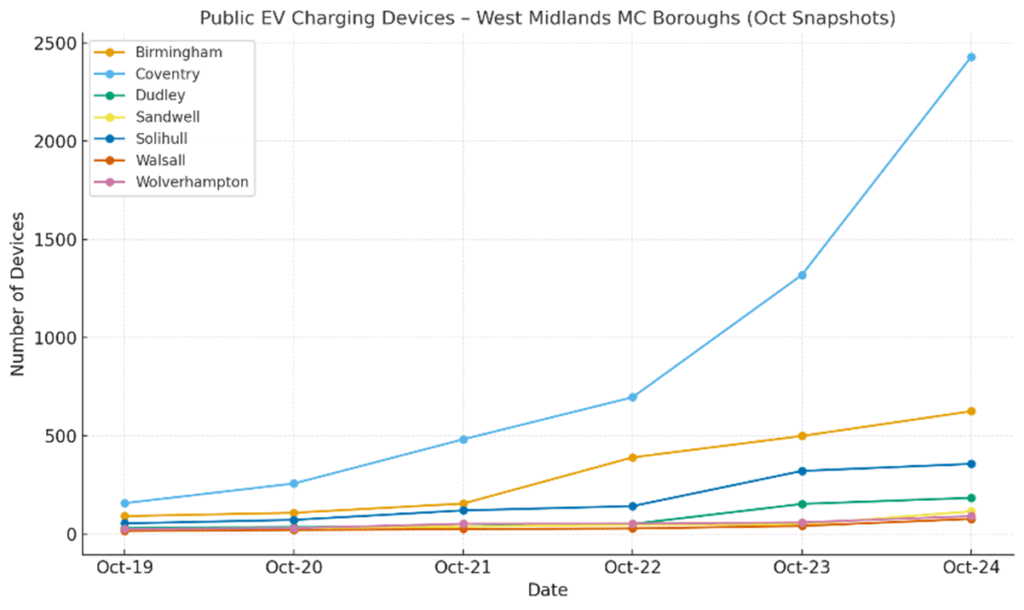
Analysis of the individual boroughs within West Midlands MC from Oct 2019–Oct 2024 (Fig. 7) shows infrastructure lag in some boroughs: Walsall (from 14 to only 71 chargers) and parts of Sandwell remain far behind the metropolitan average; without targeted support they risk being EV “cold spots.”
Challenges and Gaps
The current distribution of EV charging stations throughout the region shows significant inequalities. The expansion of EV charging stations leads Coventry and Birmingham to the forefront while Walsall and Sandwell and Wolverhampton and Dudley experience slower development and remain under the metropolitan average. The growing number of EV charging stations will create substantial challenges for local authorities to handle installation work and maintain reliable services. The Public Charge Point Regulations establish a requirement for public EV charging stations to operate at 99% availability on average. The increasing number of EV charging stations in the West Midlands will generate operational challenges and compliance issues for local authorities with limited staff resources.
Strengths / Opportunities
Birmingham and Coventry show especially strong growth in the charging infrastructure over time (Birmingham from 90 to over 1,000 chargers and Coventry from 156 to nearly 2,500), this makes Coventry one of the most densely equipped with EVs chargers’ areas in the country. The regional trajectory mirrors the national picture of crossing 40,000 public chargers in early-2023 and 70,000 in late-2024, showing the region is keeping pace with national infrastructure provision. The increase growth in high-power chargers that was evident from 2022 onwards means the growth is in quantity and quality. With >4,000 chargers in the West Midlands MC area, the residents and visitors have the chance of finding public charging, which can help reducing range anxiety and supporting EV adoption.
Conclusions and Recommendations
In the UK, achieving the national target of at least 300,000 public charge points by 2030 according to the National Audit Office, is on track. But with only 5 years ahead, the regions need to leverage their strengths to support the Government. In the case of the West Midlands, the region retains substantial automotive capabilities and clustering effects that present opportunities for EV industry development. Research suggests the region can leverage these strengths by capitalising on upper-end technology capabilities and establishing leadership in low-carbon vehicle technologies (D. Jarvis et al., 2012; Berkeley et al., 2012). The West Midlands can leverage its existing automotive manufacturing capabilities, attract investments in the electric vehicle industry and create regional employment opportunities by following this top 5 strategies.
- Build on the current manufacturing strengths
Use the West Midlands potential to host battery production, vehicle assembly, charging-infrastructure firms, and maintenance services.
- Target infrastructure gaps
It should be a priority to fund high-power chargers and grid upgrades in the lagging boroughs. Providing a reliable and accessible EV charging network supports economic growth and creates jobs, ensures equitable access, accelerates the region’s net-zero transition, and ultimately strengthens the region’s infrastructure and supports the future of transport.
- Promote the benefits.
Address misconceptions and communicate benefits such as improved air quality, reduced noise pollution, and support for the region’s net-zero targets, as well as, lower running costs and reduced need for maintenance.
- Reskill the workforce.
Partner with local colleges, universities, and training providers to shift current internal combustion engine skills to battery assembly, power electronics, and charger maintenance.
- Leverage government funding
Use OZEV (Office for Zero Emission Vehicles) grants and the DRIVE35 (Driving Research & Investment in Vehicle Electrification) Funding Programme to help SMEs to develop components, software, and services for the EV ecosystem and strengthen supply chains.