

Dr Juliane Schwarz discusses her new policy briefing, exploring how the UK Catapult Network is supporting the transition to Net Zero, highlighting effective business support practices that help organisations reduce carbon emissions while driving innovation, growth, and system-wide change.
The Net Zero Challenge
In their Special Report on Global Warming (2018), the Intergovernmental Panel on Climate Change alerts about serious implications of global warming. In 2019, the UK Government committed to achieving a Net Zero emission target by 2050 as a response. Adopting low-carbon technology was seen as one of three essential areas where the UK needs to support innovation and scale-up (alongside land use and lifestyle) in its transition to Net Zero by using a whole system approach that includes power, gas, heat, and transport and how energy is supplied, managed and consumed. The UK Catapult Network, publicly funded technology and innovation centres, aims at strengthening the UK’s capability for innovation supporting Net Zero transition.
The report discusses Catapults’ business support interventions and how Net Zero considerations are addressed in support of startups, scaleups and SMEs. It aimed to spotlight good practice in Net Zero business support to answer the following questions:
- What kind of support is available within the catapults?
- How is Net Zero embedded in support interventions (both methodically and unintentionally)?
- How can this be further enhanced and how can it be applied to other sectors and catapults?
What kind of Net Zero business support is available within Catapults?
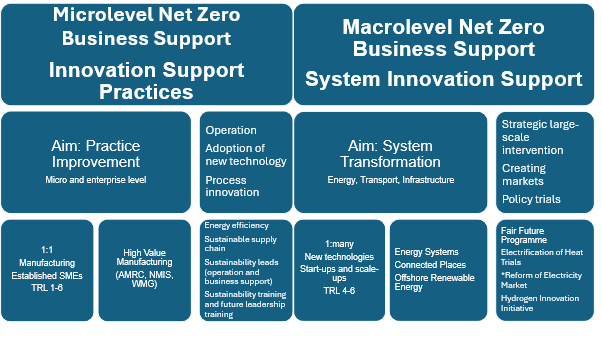
The report identifies two distinct approaches to supporting Net Zero in the Catapult Network:
–Support Practices at the enterprise level help individual businesses advance Net Zero goals through practical improvements in daily operations, technology adoption, and process innovation (microlevel transition).
–System Innovation Support focus on large-scale, strategic interventions aimed as system transformation, e.g., Energy, Transport (macrolevel transition).
How is Net Zero embedded in business support interventions?
Net Zero Microlevel Transition Support
Microlevel Net Zero business support practices, aim to embed sustainability deep into the fabric of an enterprise potentially influencing every aspect of business, including strategy and planning, operations and energy management, supply chains and partnerships, as well as organisational culture.
Good practice that supports businesses on micro level are:
– Energy Saving and Optimisation: Support practices range from simple energy-saving measures (installing energy-efficient lighting) to full process optimisation, e.g., changing entire workflows and production processes to reduce energy use, cut waste, and increase overall efficiency or upgrading to renewable energy systems.
– Net Zero Training: Sustainability and Net Zero focused business support workshops equipped participants with the latest regulatory insights and practical guidance. Combined with opportunities to reflect on organisational values and sustainability goals, these sessions helped businesses strengthen their market position, reach new customers, and improve competitiveness.
– Perception and Benefits: Help businesses to recognise the commercial benefits of Net Zero by challenging misconceptions around cost and demonstrating how sustainability initiatives can drive efficiencies, reduce expenditure, and unlock new growth opportunities.
– Sustainability campions and leaders: Appointing sustainability leads is an important first step; however, their success depends on being fully integrated into organisational management structures and supported by both senior leaders and operational teams.
– Net Zero Leadership Training: Enhanced leadership capacity to support sustainability and innovation goals, establishing leadership as a critical enabler of embedding sustainability throughout core business operations and long-term business strategy.
– Embedding sustainability into personnel development planning: Embedding sustainability in career progression frameworks, reward systems, and leadership pathways signals organisational commitment and reinforces its strategic importance.
Net Zero Macrolevel Transition Support
Macrolevel Net Zero business support focuses on whole systems and acknowledges that critical infrastructure sectors such as Energy, Water, or Transportation are best understood and theorised in terms of socio-technical systems.
System‑wide effects align business support directly with national and global Net Zero objectives and enables support to reach a higher volume of SMEs, amplifying overall impact on Net Zero transition. These effects include policy trials; the creation and shaping of new markets; increases in markets’ absorptive capacity through the introduction of innovative approaches and the removal of barriers to adoption; and changes in regulations and broader government policy interventions.
Good practice examples for Energy transition:
- Fair Future Programme highlight low-income/vulnerable consumers and how they can be supported by policy interventions
- Electrification of Heat Trials working on barriers to large-scale rollout of heat pumps.
- Reform of Electricity Markets Recommends moving away from a single national pricing system towards local electricity pricing, aligning costs more closely with where power is produced and where it is used.
How can good practice in Net Zero business support further enhanced and applied to other sectors and catapults?
Both micro-level and macro-level approaches have unique goals, reach, and operational focus. Collaborations of different catapults can help to recognise these differences and enable better alignment of projects to maximise the impact of individual Catapults.
Good practice examples of cross-Catapult collaborations:
- Enabling Conditions Programme: The first high-level cross-Catapult programme focused on shared learning and Net Zero capability building; it helped define strategic priorities and enabled new cross-Catapult collaborations resulting in:
- Hydrogen Innovation Initiative to support the emerging hydrogen economy.
- Net Zero Living Programme to reduce carbon emissions in local authorities, businesses and communities.
Impact
Both micro-level and macro-level approaches in business support are vital and complementary, but they rarely co-exist within the same Catapult.
Distinct Scope and Objectives: Each approach has unique goals, reach, and operational focus. Collaborations of different Catapults can enable better alignment of projects and maximise the impact of individual Catapults.
Unique Insights and Good Practices: Both approaches generate valuable insights and examples of good practice in Net Zero business support, creating opportunities for knowledge exchange and collective learning across the network.
Tailored Support: Businesses benefiting from these approaches differ significantly by sector (e.g., cleantech vs. manufacturing) and stage of maturity (startups vs. established firms). Differentiating by sector and maturity ensures that support programs are relevant and effective for diverse business needs.
Strategic Clarity: Understanding the complementary nature of these approaches helps policymakers and Catapults design targeted interventions that leverage strengths rather than duplicate efforts.
These outcomes are significant because they tackle systemic barriers to innovation and sustainability in the UK. By strengthening collaboration across Catapults, they enable a more coordinated and scalable approach to delivering Net Zero ambitions. They emphasise strategic alignment, long-term investment, cross-institutional collaboration, and cultural integration of Net Zero principles, all of which are critical for achieving national climate and innovation targets.
This blog was written by Dr Juliane Schwarz, Research Fellow, City-REDI, University of Birmingham.
Disclaimer:
The views expressed in this analysis post are those of the author and not necessarily those of City-REDI or the University of Birmingham.